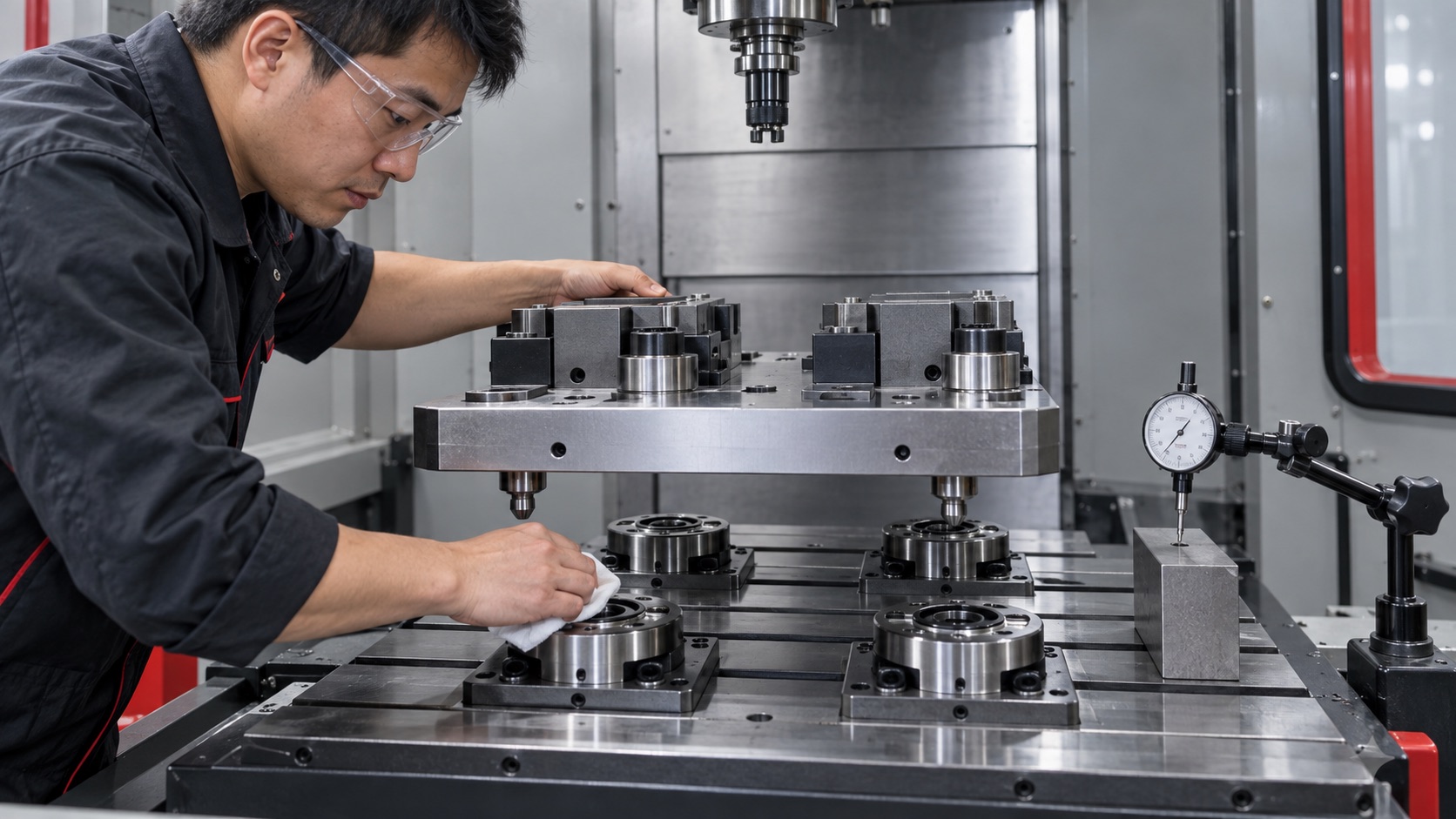
A zero-point system reduces changeover work, but the module alone cannot guarantee the location of the finished part. Chips on a seat, damaged pull studs, an unstable pallet or a datum stack above the interface can move the workpiece. Repeatability should be specified and measured at the feature that matters to production.
Map the complete datum stack
Trace location from the machine table through the clamping module, pull stud, pallet, fixture locators and workpiece. Identify which surfaces locate and which only clamp. A repeatable module cannot correct clearance or deflection introduced by the upper fixture, so the acceptance point should be on a fixture master or workpiece datum.
Design for clean seating and service
Keep locating contacts away from chip traps and provide accessible cleaning paths. Protect pull studs and module faces during storage, and replace damaged wear elements before compensating them in the program. Pallet lifting points and handling clearances reduce the chance of striking a locator during changeover.
Verify after a real changeover
Measure a master feature, remove the pallet, clean and reinstall it using the approved clamp sequence, then repeat several cycles. Check clamp confirmation and compare cold and operating conditions when heat is significant. Vietlink Precision can machine pallets, modular fixture plates and verification artifacts, with inspection data aligned to the customer's machine and part datum.