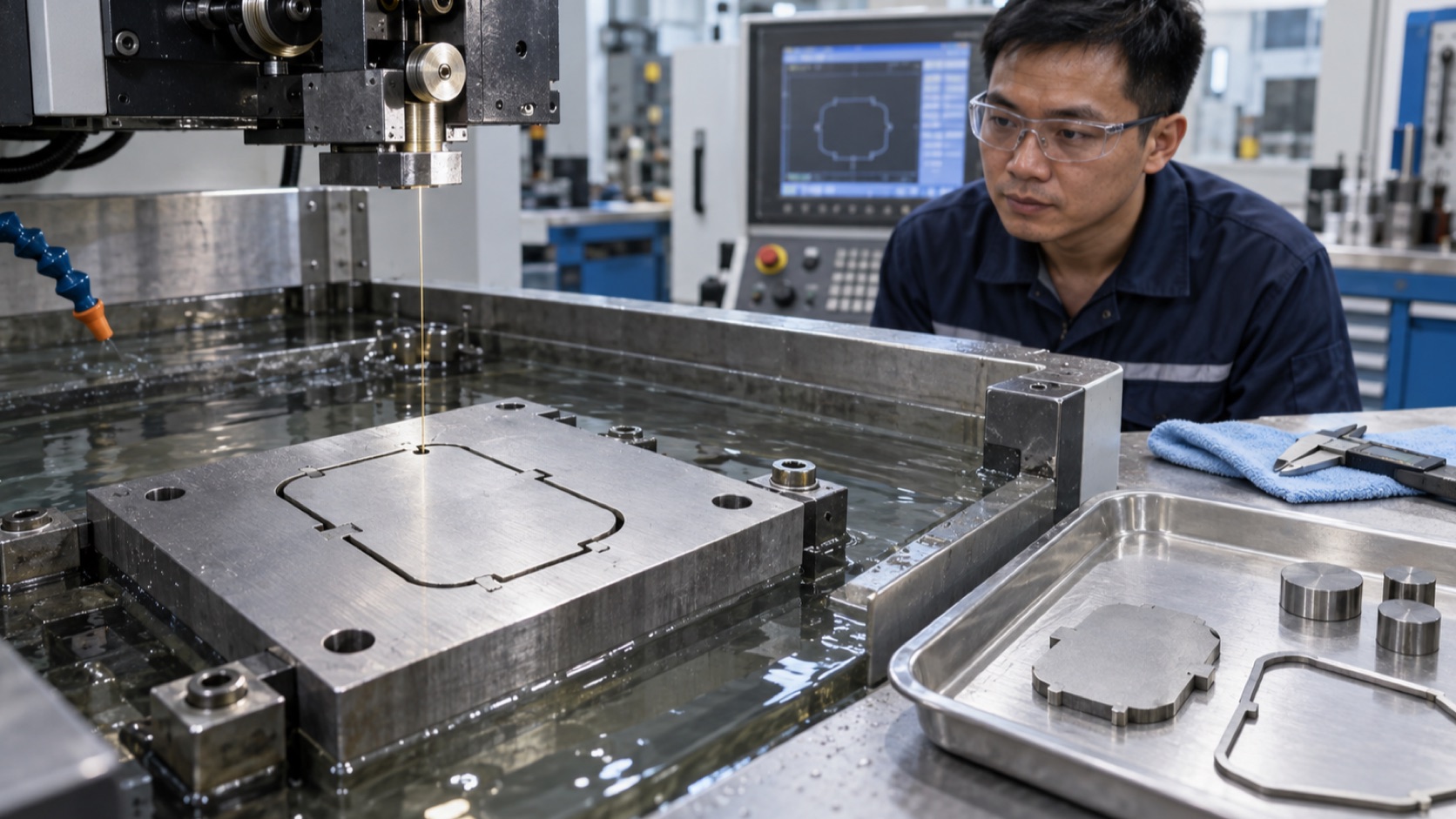
A closed profile needs an internal start hole, but the larger risk often appears near the end of the rough cut. If the core drops or rotates before the skim passes, it can trap the wire, damage the surface or move a thin workpiece. Start-hole and slug strategy belong in the process plan, not as an operator improvisation.
Place a start hole for reliable threading and material removal
Choose a diameter and location that the automatic threader can enter while leaving enough stock from the final contour. Consider plate thickness, flush conditions, taper, heat-treatment scale and whether the start can be placed in scrap. For very small, deep or hardened work, a dedicated small-hole EDM process may be needed before wire cutting.
Keep the slug controlled until the process is ready
For a heavy or valuable core, use planned tabs, staged cut paths, clamps or multiple starts rather than allowing an uncontrolled drop. Position tabs where they can be removed without touching a critical corner or sealing edge. If stress release can move the plate, rough symmetrically, leave stock and allow the work to stabilize before finish passes.
Remove, rethread, skim and inspect in a defined sequence
Support and remove the slug with the machine stopped, clean the gap and confirm the work has not shifted. Rethread from an accessible location and run the specified skim strategy. Inspect size, location, taper, corner condition and recast or edge damage; record the program revision, wire, offsets and inspection result with the part.