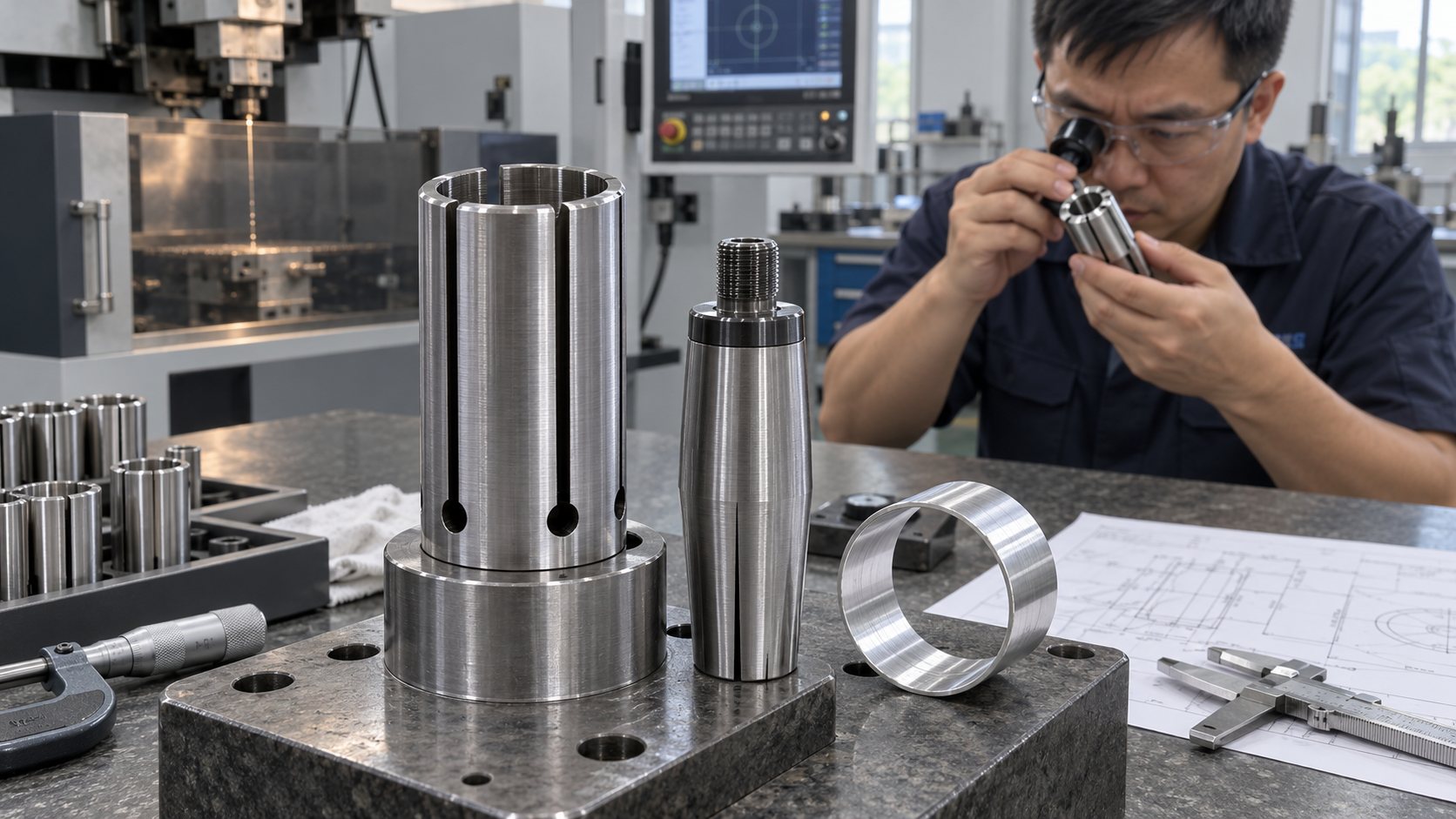
An expanding mandrel can hold a ring or bushing from its bore when outside jaws would block the tool. It works best when the bore is already suitable for location and the required expansion is small and controlled. A slotted sleeve is not a universal clamp for every bore size.
Check whether the bore is a usable locating feature
Identify the bore's size range, roundness, surface condition and relationship to the feature being cut. A rough or tapered bore can make the workpiece tilt even when the mandrel feels tight. Define the axial stop separately. For thin rings, compare the required cutting torque with the distortion caused by expansion; stronger clamping can create a round part in the fixture that becomes out of round after release.
Plan turning, heat treatment and wire EDM as one route
The sleeve, taper and draw mechanism need a material and heat-treatment specification suited to their required elastic travel and wear. Plan cylindrical finishing relative to the fixture mounting datum. Wire EDM can produce narrow slots in conductive steel, but slot width, end relief, remaining wall and cut sequence must follow the approved design. Account for material movement after slotting and specify finishing passes and slot-root condition where needed.
Inspect the mandrel at its working condition
Measure the relaxed sleeve, then test at the specified actuation stroke or tightening condition using a representative workpiece or master ring. Record workpiece runout, axial seating and free-state dimensions after release. Check that the part can be removed without forcing and that chips do not accumulate in the slots. Repeated cycling should confirm return behavior; a short sample test does not establish unlimited fatigue life.
Quote the sleeve together with its mating parts
Provide sleeve and taper drawings, workpiece bore limits, wall thickness, cutting direction, required torque capacity, actuation method, runout target and expected cycles. Include the base interface and replaceable-sleeve requirements. For a new fixture, agree a sample gripping test before batch manufacture. Keep the approved working range with the fixture so operators do not use extra draw travel to compensate for an oversized bore.