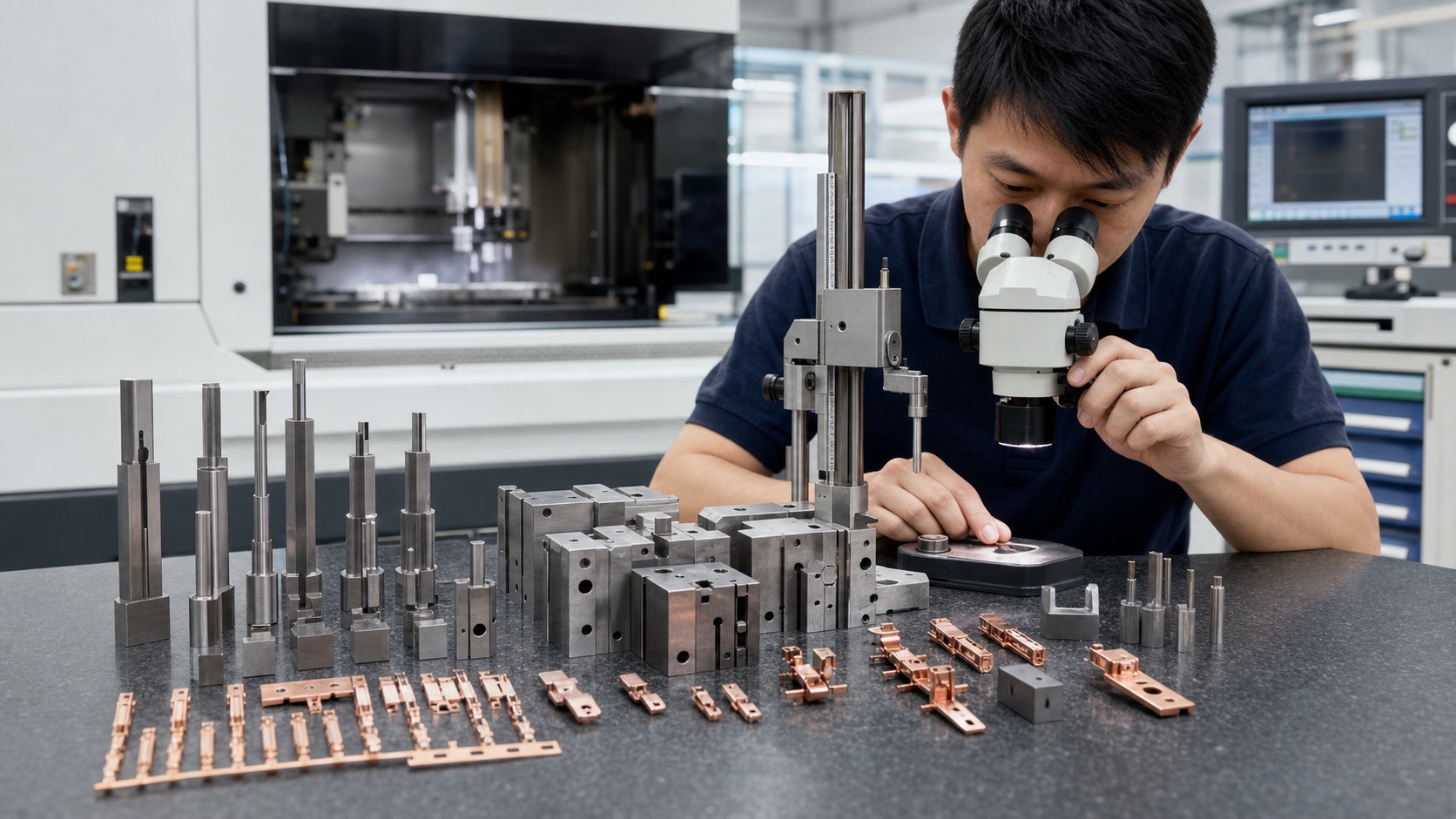
Thin connector terminals require accurate punch profiles and stable punch-die clearance. Small errors can increase burr height, distort terminal legs or shorten tooling life.
Set clearance for material and thickness
Copper, brass and terminal alloys have different strength and hardness. Punch-die clearance should reflect material, thickness and edge requirements rather than one percentage for every part.
Program profiles and fine corners
Wire EDM suits closed profiles, fine corners and hardened tool steel. Start-hole location, skim-cut count and wire offset directly influence final size.
Control heat treatment and datums
A common route is rough machining, heat treatment, datum grinding and then wire EDM. This sequence protects the relationship between cutting edges and die mounting surfaces.
Inspect burr and trial stampings
Punches and inserts should be measured, but real-material trials are also required to evaluate burr height, edge direction, distortion and part release.