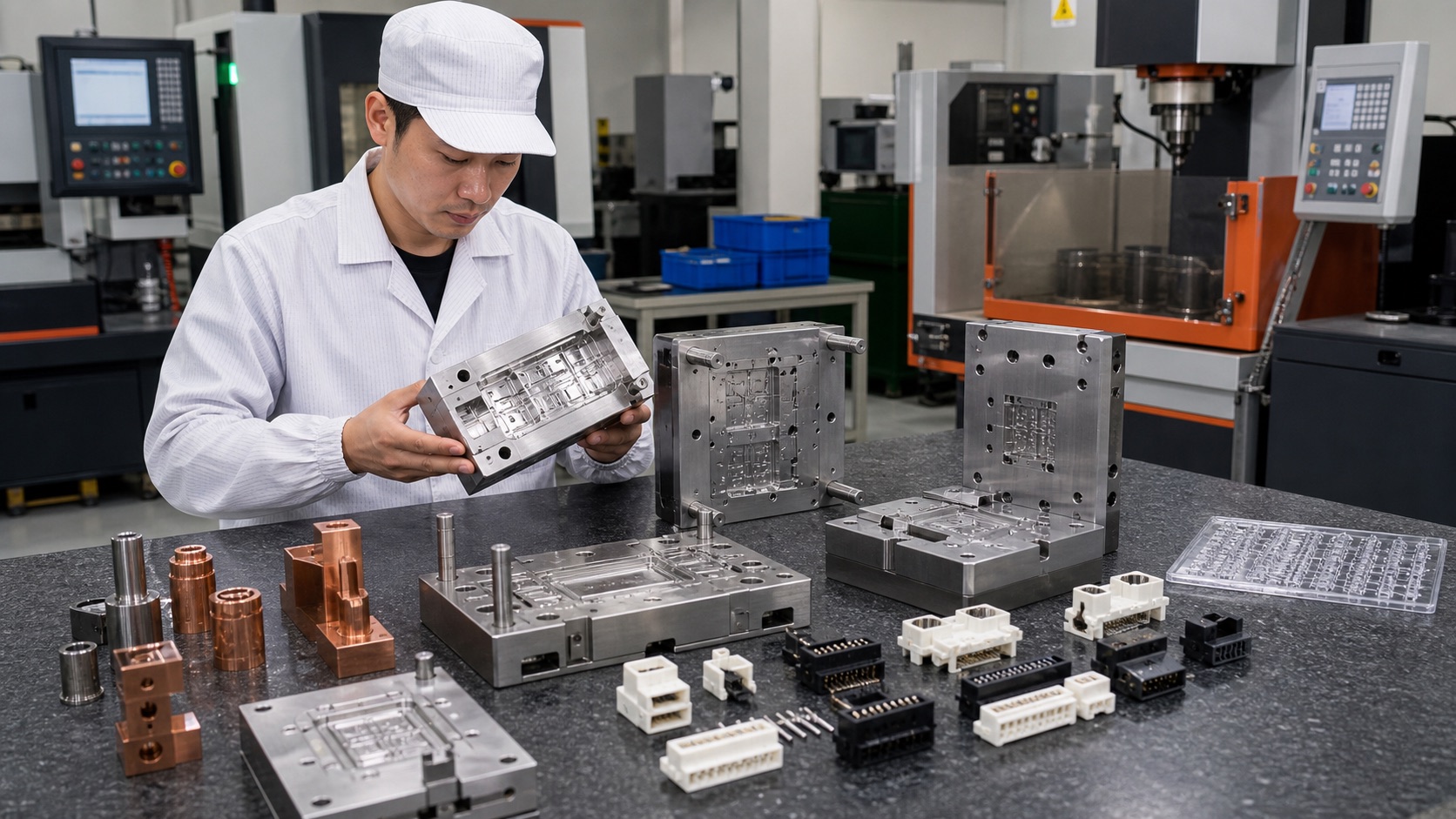
Before committing to production tooling, customers often need real material samples to check fit, shrinkage, pin alignment and functional details. Trial tooling reduces risk before the full mold stage.
When trial tooling is useful
Use trial tooling when the product structure is still being verified, or when the part must fit with a PCB, terminal or metal cover. For small connectors, pin locations, ribs and snap-fit features should be tested early.
Material and finish choices
Depending on sample quantity, inserts may be made from aluminum or steel. Aluminum is faster for design checks, while steel is better for repeated trials. Sharp details, deep ribs and small slots may require CNC, EDM and polishing.
DFM before cutting the insert
Draft angle, wall thickness, gate location, parting line, ejector position and shrinkage risk should be reviewed before machining. A small change at this stage can prevent expensive tooling changes later.
From trial samples to production tooling
After sample fitting and measurement, every change should be recorded in the drawing or 3D model. This helps transfer the learning to production tooling or the next insert without guesswork.