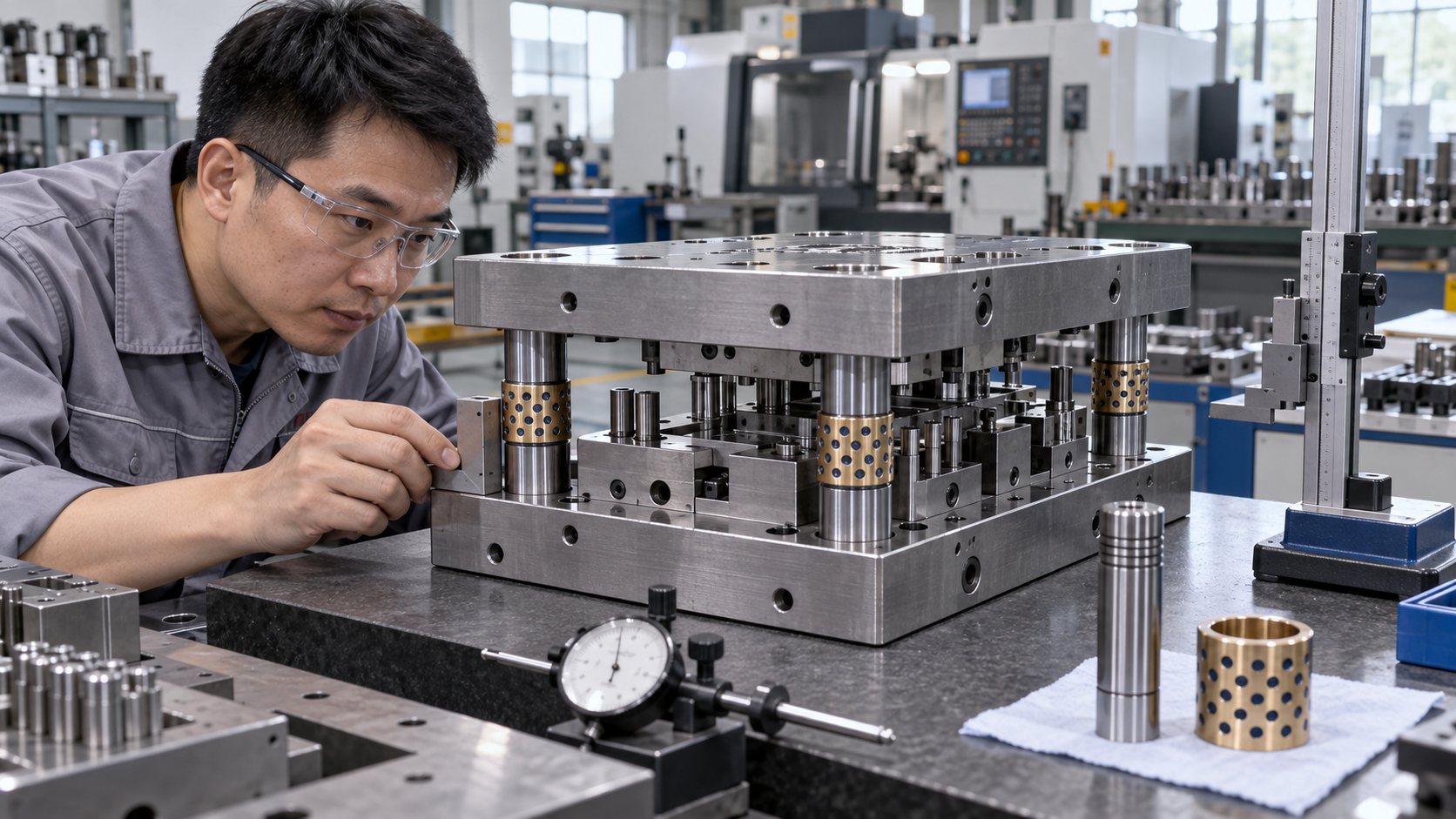
A new guide bushing may wear quickly if the post seats or die plates are misaligned. Treat the post, bushing, mounting seat and plate datums as an assembly. Replacing only the visibly damaged component can leave the cause of one-sided contact untouched.
Identify the guidance system and the wear pattern
Record the guide component series, mounting style, engagement length, lubrication and die opening conditions. Plain and rolling guide systems have different interfaces; a nearby nominal diameter does not establish compatibility. Mark one-sided scoring and relate it to the plate orientation. Check die and press alignment and lateral loads with the responsible tool designer instead of expecting the guide posts to absorb every side load.
Machine the mounting seats from a common datum plan
Reference upper and lower plate coordinates to the approved die-set drawing. Rough the plates and perform specified stabilization or heat treatment before final seat finishing. Control mounting-face flatness, seat position and post-axis orientation. Use the selected component supplier's mounting fits rather than a general press-fit rule. Specify which interfaces are finished by boring, reaming or grinding and how they are measured.
Inspect after installation as well as before it
Measure the loose seats and the installed guide geometry; fitting a post or bushing can change the assembly. Check the permitted working stroke, entry and contact condition with the plates supported in the defined state. Follow the die and equipment trial procedure, recording local resistance rather than forcing the assembly closed. Alignment must also be checked against the punch and die relationship, not just whether the plates can move.
Define a repair package that addresses the cause
Supply plate drawings, guide references, material and hardness requirements, damaged samples, wear photographs and the original datum scheme. State whether the request is for seats, replacement parts or an assembled die set. Agree how worn bores will be restored and whether standard replacement components remain usable. An inspection record that links repaired seats to assembled alignment is more useful than a new bushing diameter alone.