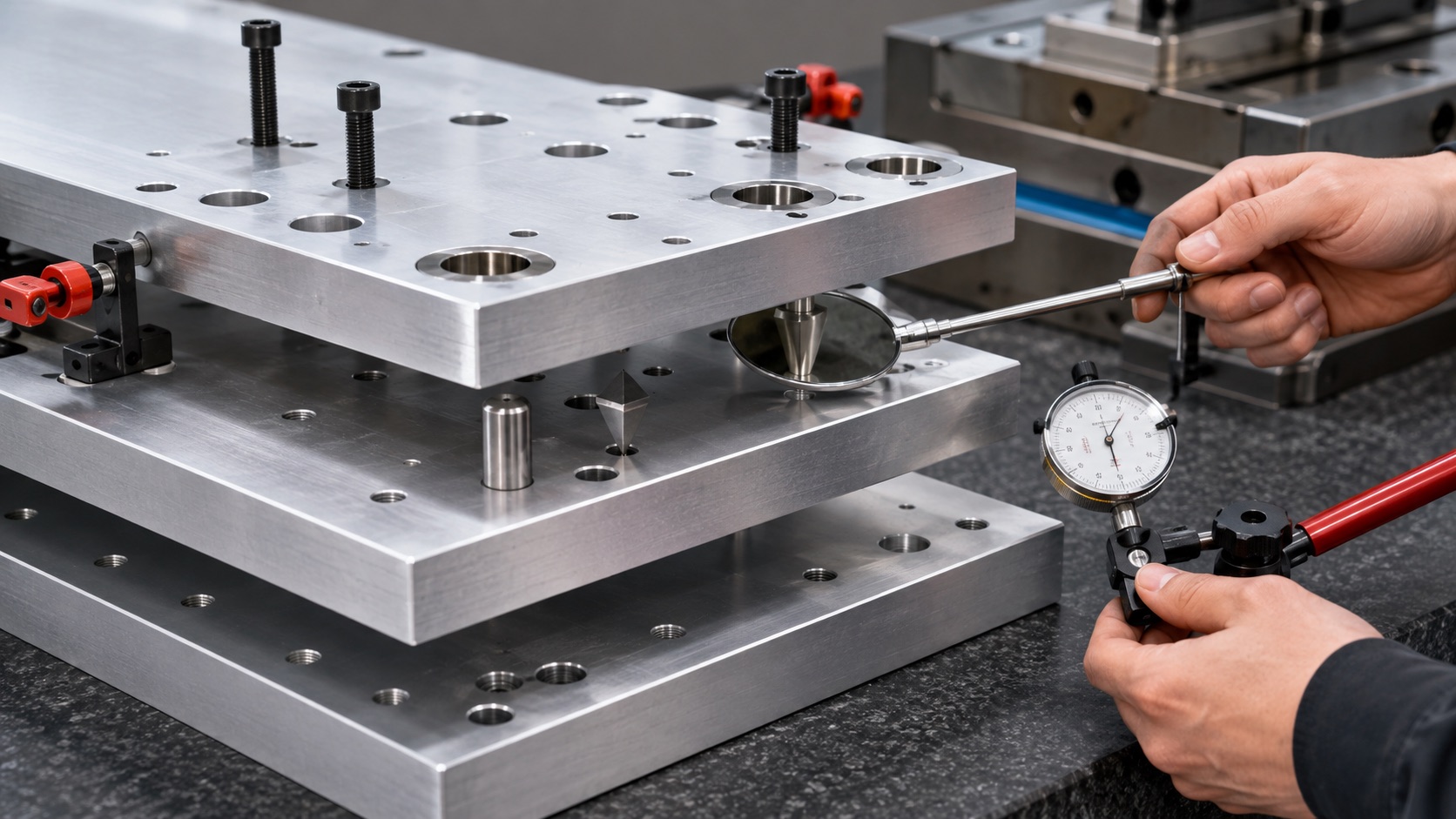
Two accurate round pins can make a removable plate difficult to assemble because their spacing and the matching holes cannot be perfectly identical. A common approach is to let one round pin establish position in two directions and let a relieved or diamond pin control rotation while allowing harmless spacing variation.
Decide which plate owns the datum
Select the base or master plate that defines the coordinate system. Its locating features should be related directly to the machine key, pallet or inspected datum. Upper plates receive matching holes or bushings; screws provide clamping and should not quietly become uncontrolled locating elements.
Constrain position without overconstraining spacing
Use the round pin as the primary in-plane locator. Orient the relieved direction of the second pin along the line joining the two pins so it controls rotation but accepts small center-distance variation. Two close-fitting round pins can bind as temperature, hole spacing, wear and contamination change.
Make wear and assembly damage replaceable
Hardened bushings protect aluminum plates and can be renewed without remachining the whole tool. Provide a lead-in chamfer, lifting clearance and a way to remove the bushing or pin. Keep locating contacts clean and away from chip collection pockets; forcing a plate down with screws can damage both pins and holes.
Verify repeatability after complete disassembly
Measure a functional feature or gauge point, remove the plate, clean and reinstall it using the defined tightening sequence, then repeat over several cycles. Check cold and operating conditions if temperature changes are meaningful. Vietlink Precision can machine fixture plates, pins, bushings and inspection features; the acceptance plan should state the required repeatability at the workpiece datum.