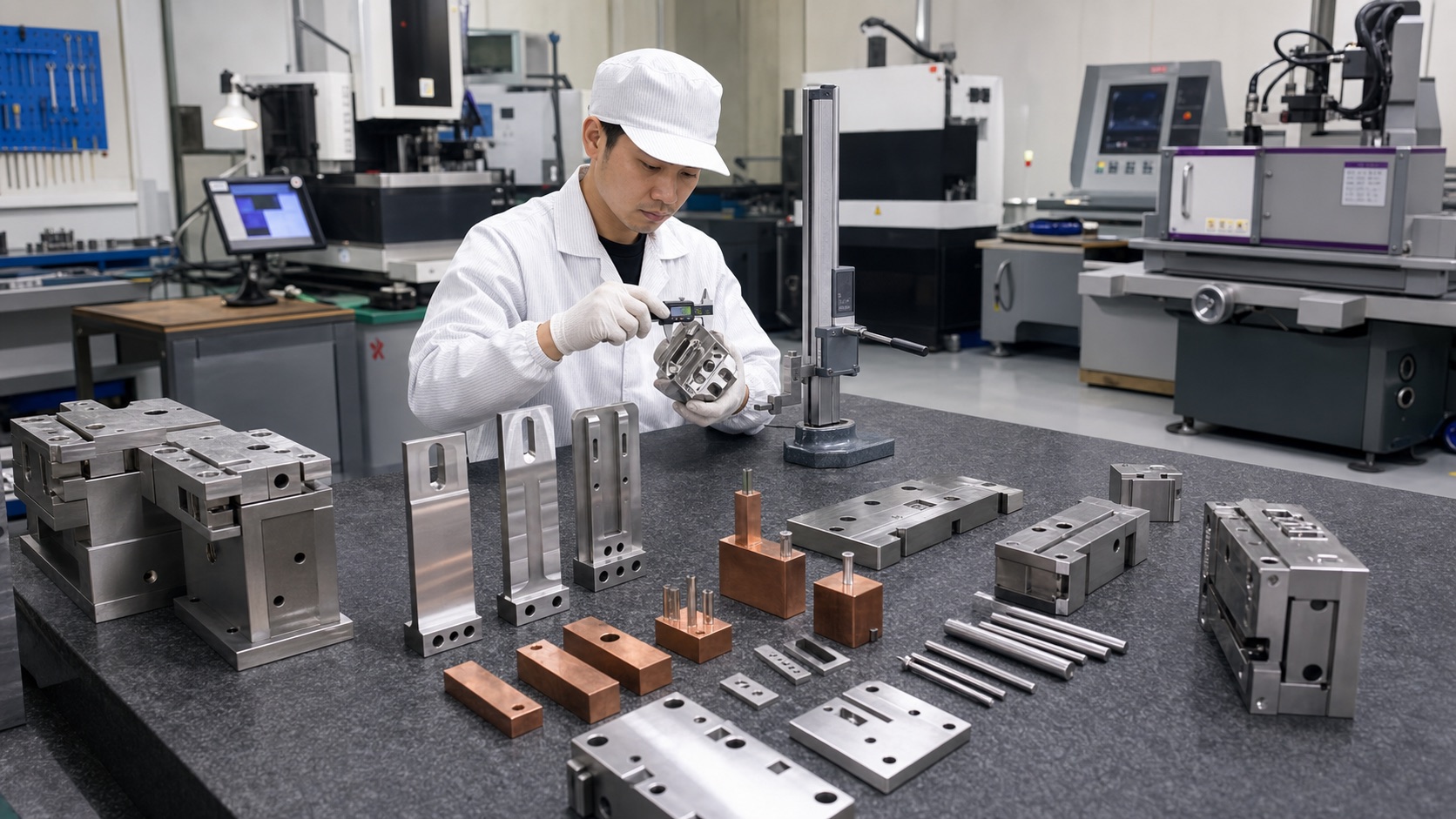
Many mold and tooling parts cannot be made efficiently by CNC milling alone. Small internal corners, deep slots, hardened materials and special surfaces often require EDM, wire cutting, grinding and precise inspection.
CNC milling covers most open geometry
Flat faces, open pockets, screw holes, steps and outside profiles can usually be milled. Tool radius limits internal corners, so the design should identify areas where a cutter cannot reach.
EDM handles deep corners and difficult negative shapes
For deep slots, sharp internal corners or cavities that are difficult to mill, EDM electrodes can produce the required geometry. Electrode lead time and EDM surface requirements should be considered.
Wire cutting is useful for through profiles and accurate plates
Wire cut is suitable for through profiles, narrow slots, plate inserts and parts requiring accurate edges. When inserts must fit together, clearance and datum position after cutting are important.
Grinding and inspection protect final flatness
For inserts and blocks requiring high flatness or parallelism, grinding may be the final step. Height gauges, pin gauges and datum checks help confirm fit in the mold or fixture.