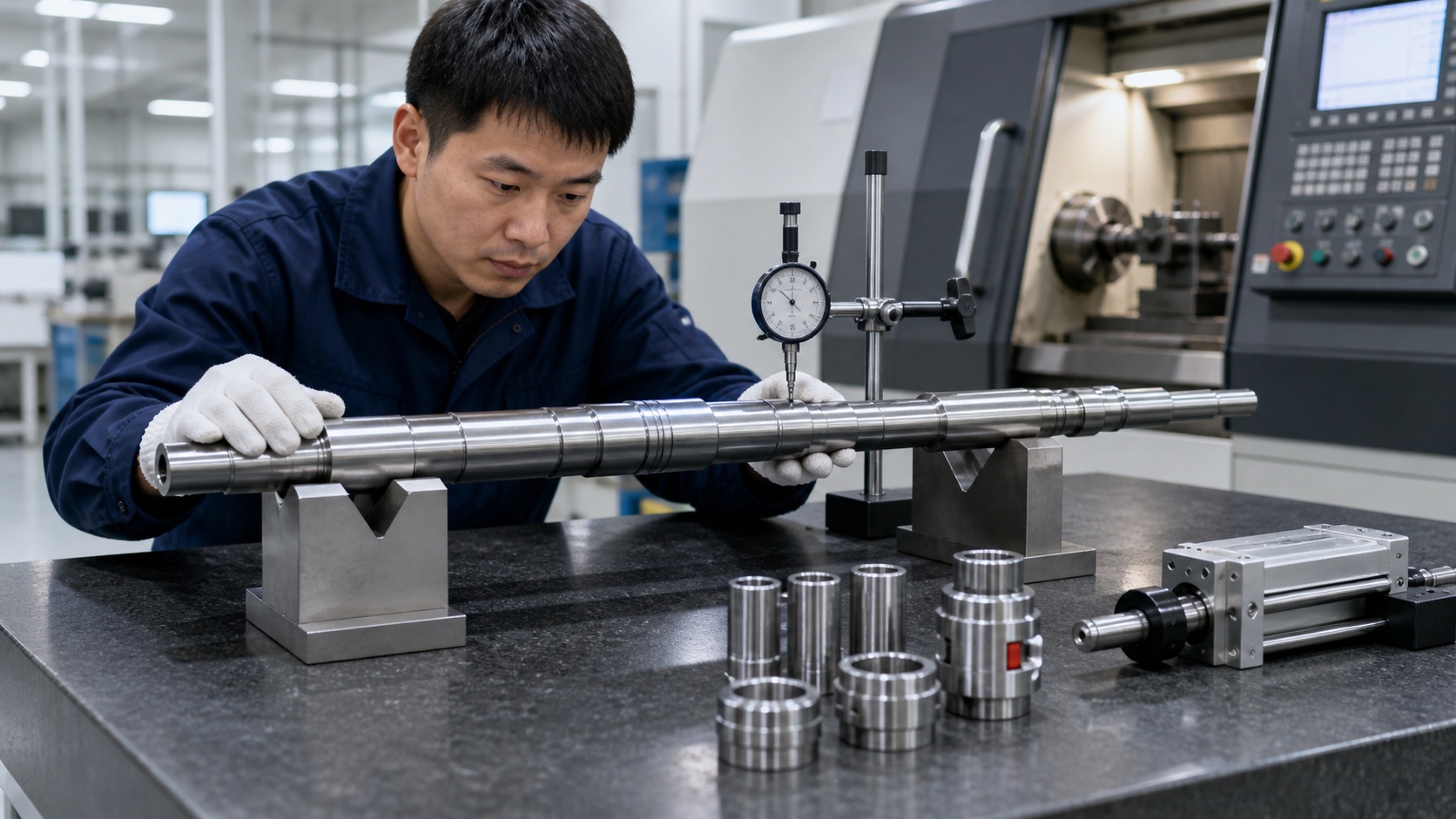
Every diameter may measure correctly while the shaft still vibrates or binds because journals are not coaxial, the shaft is bowed or shoulders are out of square. The process must preserve a center datum through turning, heat treatment, grinding and assembly checks.
Start with straight stock and balanced allowance
Check incoming straightness, material condition and diameter allowance for all journals. Balanced rough turning around the centerline, with stock left for heat treatment and grinding, reduces stress-driven movement.
Preserve one center-datum system
Center holes, end faces and reference journals must be protected. Centers, steady rests or suitable fixtures support a slender shaft without forcing it straight, and functional features should be finished in as few setups as practical.
Sequence turning, heat treatment and grinding
Where hardness and bearing surfaces are required, the route may include rough turning, stabilization or heat treatment, permitted straightening and finish grinding. Threads and keyways are positioned according to distortion and burr risk.
Inspect the shaft as an assembly component
Diameter and shoulder length are not enough. Check journal-to-journal runout, straightness, shoulder squareness, finish and, where required, trial fit with bushings, couplings or the actuator.