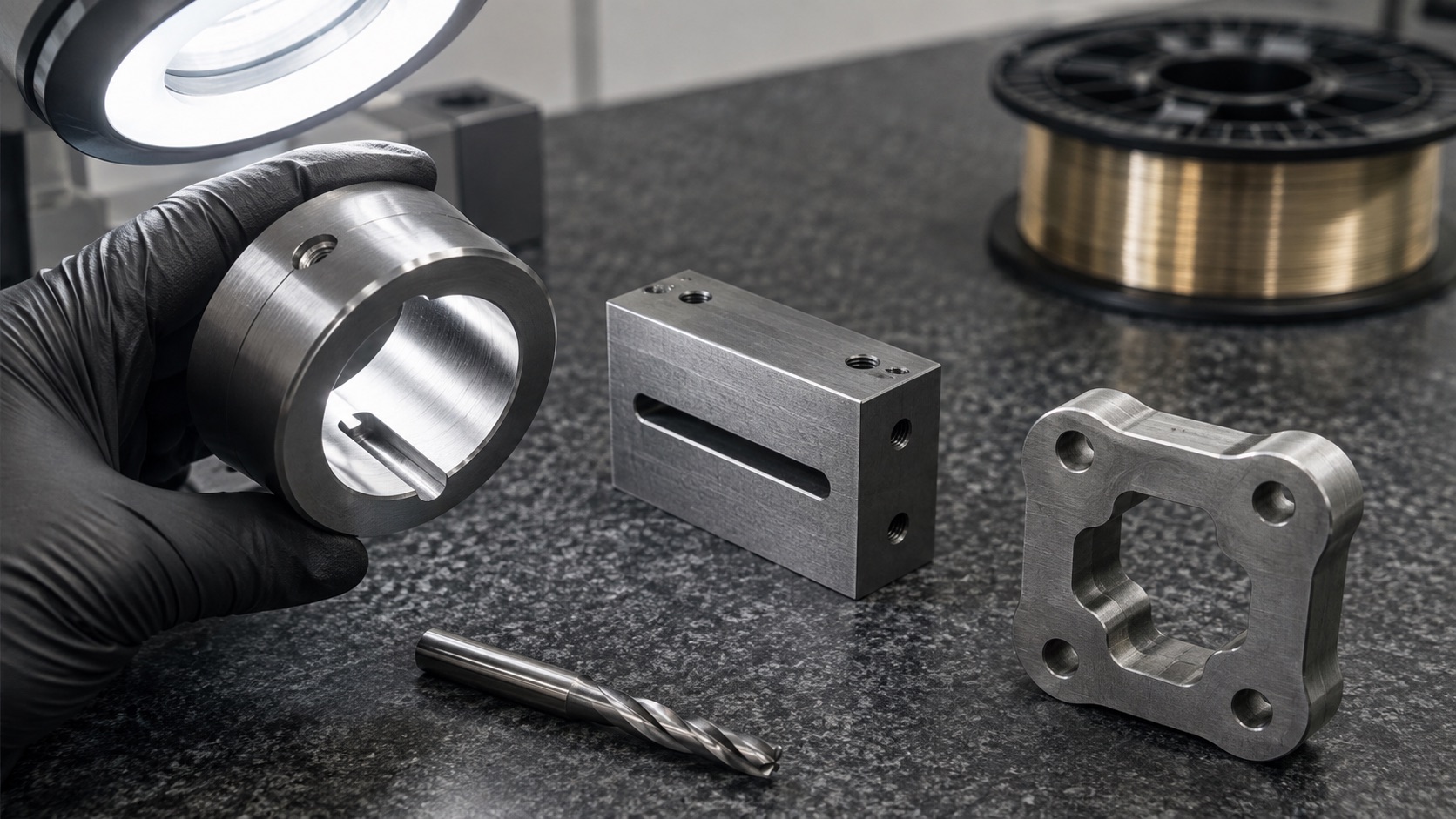
An internal keyway may look simple on a drawing, yet tool access, corner shape and material condition can change the process completely. Decide from the functional fit and available opening, rather than naming a machine before the geometry is reviewed.
Start with access and the required bottom condition
An open slot reachable from an end can often be milled efficiently. A straight internal keyway in a bore may require dedicated access, while a closed-end keyway needs another plan and cannot be treated like a through feature. State whether the slot must pass through, stop at a depth, include a runout relief or accept a tool radius.
Use wire EDM when the profile and material justify it
Wire EDM needs a conductive workpiece, a through path for the wire and usually a start hole for an enclosed profile. It is useful for hardened inserts, narrow straight-through slots and non-round holes with controlled profiles. It is not automatically the cheapest choice: threading, rough and skim cuts, flushing and slug control all affect time.
Review fit, corners and datum relationships
For a shaft and hub, define key size, fit, orientation to the bore and the functional datum. Avoid specifying a perfectly sharp internal corner unless assembly truly requires it; milling leaves a radius, while wire EDM also has a finite wire and spark-gap radius. Inspect slot width, symmetry or angular position from the same datum used by the mating assembly.
Quote the complete part, not an isolated slot
Send the 3D model and 2D drawing, material and hardness, heat-treatment state, surface requirement, quantity and mating-part information. Vietlink Precision can compare CNC milling, wire EDM and combined routing for hubs, guide blocks and tooling inserts. The quotation should identify any start hole, finishing pass and inspection method rather than hiding them in a single tolerance note.