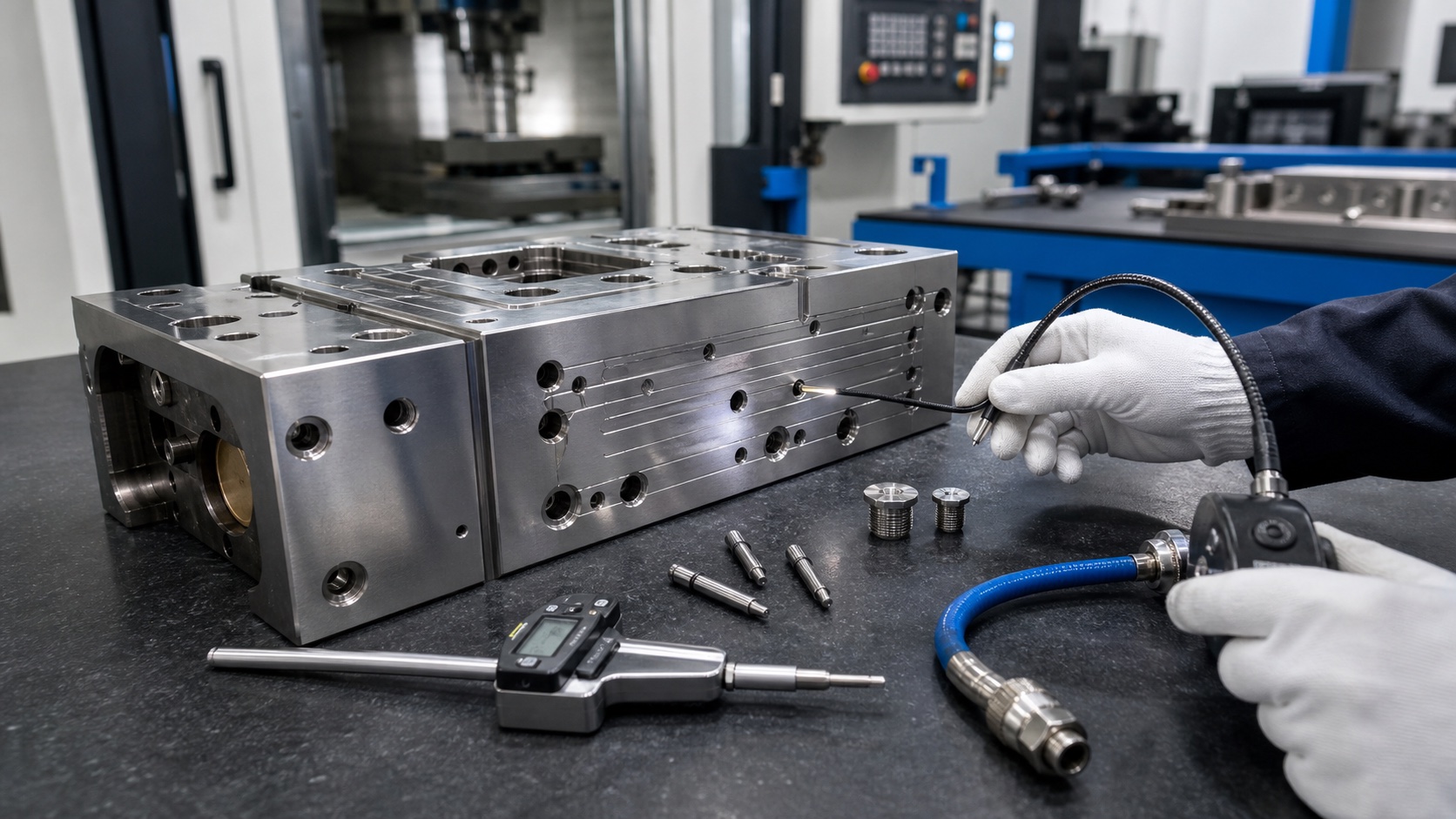
Cooling channels work only when cavity spacing is sensible, holes do not drift into other features, intersections stay clean and the circuit seals. Design, drilling, cleaning and testing should follow one controlled circuit map.
Plan the circuit before drilling
Define distance to the cavity, minimum wall thickness, tool access, hole intersections and plug locations. Ejector pins, screws, replaceable inserts and EDM details must be included in the clearance review.
Control drift in deep holes
Accurate pilot features, tooling suited to the depth-to-diameter ratio, controlled pecking and stable coolant reduce drift. Direction and depth can be checked at intermediate stages before circuits intersect.
Finish intersections, burrs and plugs
Intersection burrs restrict flow or break loose during service. After controlled deburring and flushing, inspect with a borescope where appropriate; plug threads need sufficient engagement and a defined sealing method.
Test flow as well as sealing
Pressure testing confirms a sealed circuit but not balanced flow. Verify each circuit separately for direction, flow rate, pressure drop, hold time and leakage before mold assembly.