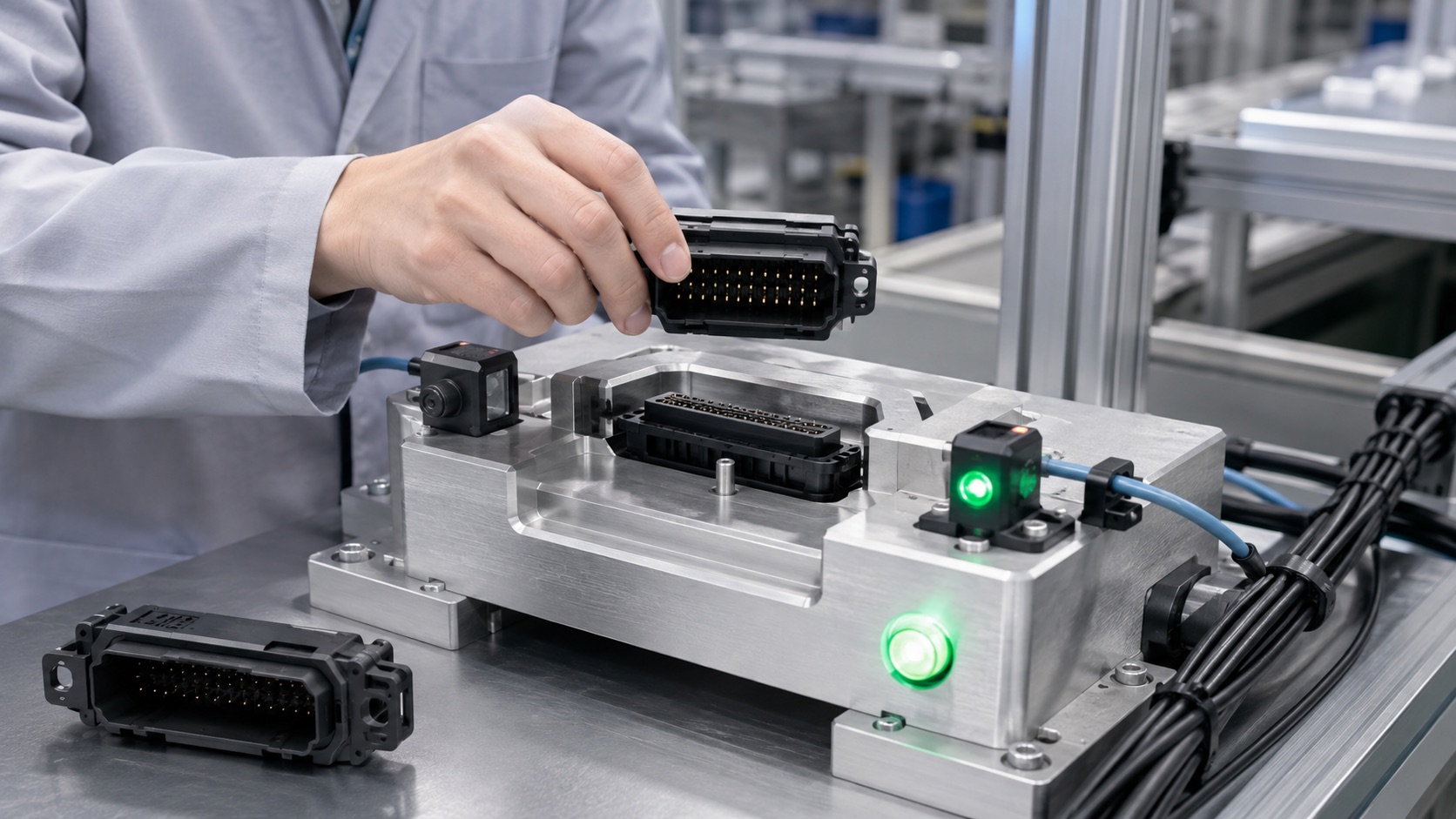
A sensor can report what it sees, but it should not be expected to correct a weak nest. The most reliable assembly station first makes the wrong orientation physically difficult or impossible, then uses a sensor to confirm presence, seating or a critical component before the cycle is released.
Use a mechanical feature to reject the wrong orientation
Base the nest on stable connector surfaces and add one asymmetric key, relieved wall or pin pattern that does not accept a reversed part. The feature should stop the part before terminals or seals are damaged. Provide chip and debris relief so contamination cannot imitate a correctly seated condition.
Ask each sensor one clear question
A simple sensor can confirm presence, insertion depth or one orientation feature; it should not be asked to infer several uncertain conditions from one marginal target. Define the expected distance, contrast or signal window using good parts and known bad samples. Keep the target away from glossy surfaces or flexible elements where readings vary.
Protect the sensing window and the fixture datum
Cable routing, connector strain relief and sensor guards belong in the fixture design. Make the sensor adjustable only where setup requires it, then lock and mark the approved position. Replaceable wear pads and bushings preserve the nest datum so sensor settings do not compensate for mechanical wear.
Challenge the station with deliberate wrong parts
During acceptance, test reversed, incomplete, missing-terminal and wrong-model samples as applicable. Repeat with different operators and after removal and reinstallation of the nest. Vietlink Precision can manufacture the CNC nest, brackets and locating components; the customer or automation integrator should validate PLC logic, interlocks and production reaction rules.