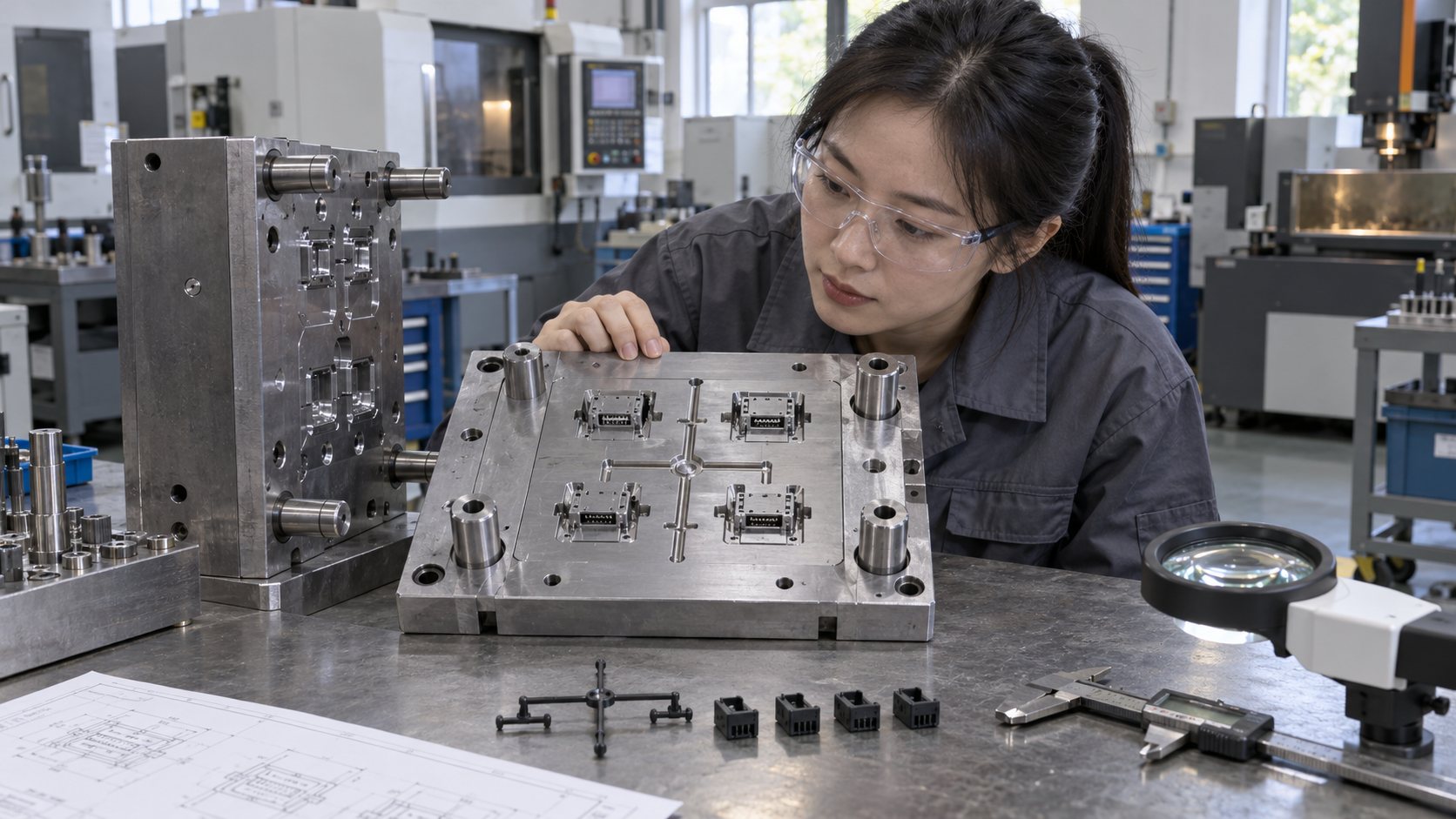
If one connector cavity is short while another flashes, increasing pressure or opening every gate can move the defect rather than solve it. Compare cavity filling under repeatable conditions, then decide whether runner geometry, gate condition, venting or a process issue needs attention.
Compare cavities with a traceable trial
Label cavities and keep samples linked to the shot and settings. After the process stabilizes, use controlled partial-fill trials and cavity-by-cavity weight or fill-front observations to see which branches lead or lag. Keep the resin grade, drying condition and machine settings recorded. Also inspect vents, gates and damage; an apparently unequal runner is not the only possible source of unequal filling.
Machine inserts to a reviewed flow layout
Review runner section, branch transitions, gate position and access for ejection or trimming with the mold designer. Similar runner lengths do not by themselves prove identical flow behavior. CNC machining and EDM can form replaceable runner or gate details, but the interface, sealing land and edge condition must remain defined. For filled resin, choose tool material and treatment around abrasion and the required production volume.
Make one controlled change, then repeat the same checks
Keep an approved baseline and identify each insert revision. A replaceable gate insert can preserve options while trial dimensions are tuned. Remove material only after the responsible tooling engineer approves the change, since reversing an enlarged gate can require repair or a new insert. Repeat filling observations, part weight and critical connector dimensions, then inspect gate vestige, flash and ejection. More complete filling is not the only acceptance criterion.
Include trial evidence in a repair or new-insert RFQ
Provide the mold and insert drawings, cavity count, resin and filler grade, gate photos, defective and acceptable samples, machine settings and required production volume. State whether the request covers machining only, design revision or trial support. Agree spare-insert interchangeability and the measurements that will close the issue. This makes the quoted work specific to a defect instead of an open-ended request to improve the mold.