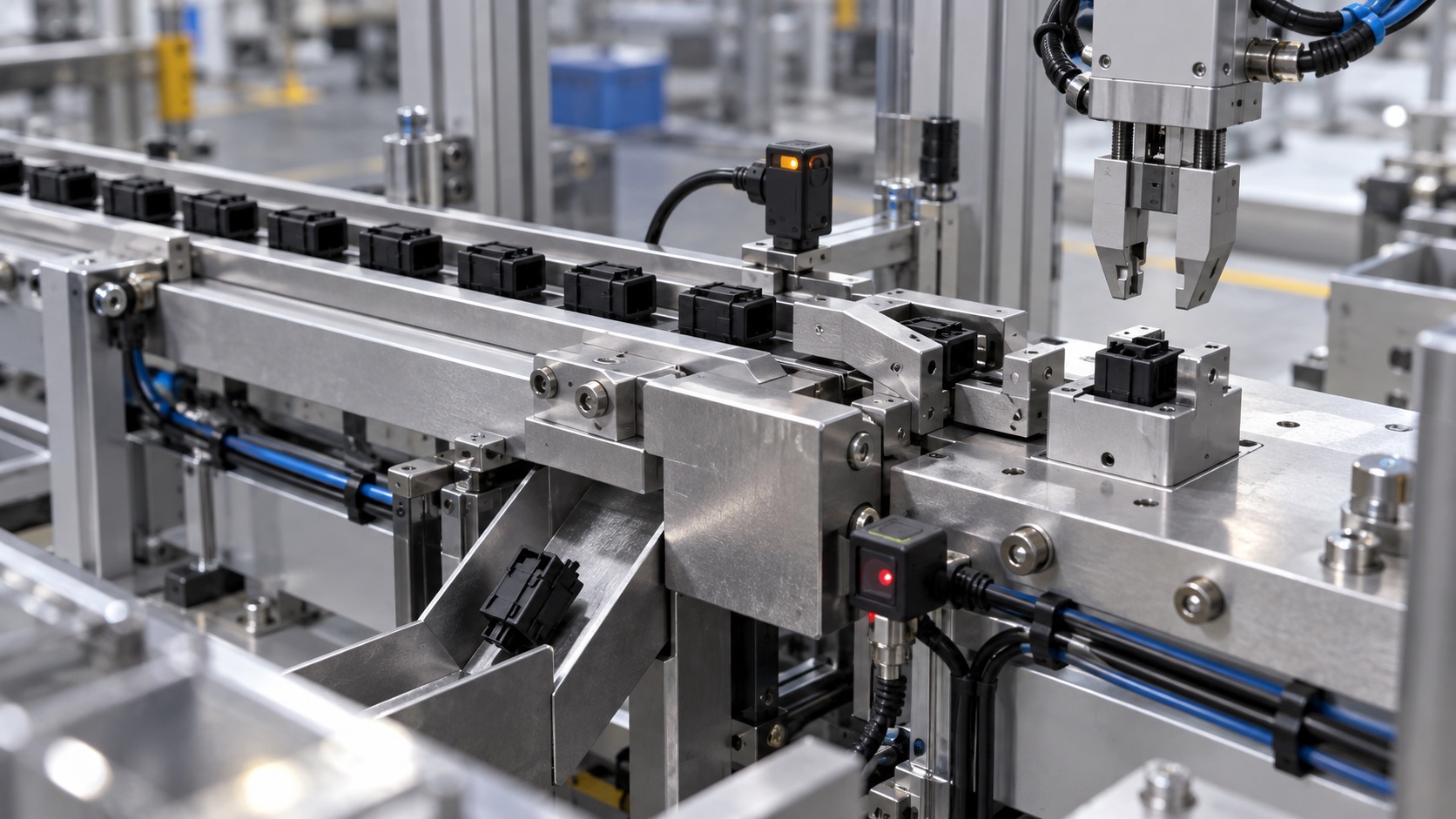
A bowl feeder may orient most connectors correctly, yet the downstream track and escapement decide whether the assembly machine receives one stable part. Variations in molding flash, static, part center of gravity and rail wear can cause jams or doubles. The solution should combine mechanical guidance, controlled separation, sensing and easy recovery.
Measure real parts and define the stable datum
Use samples from different cavities and production lots, including allowed flash and warpage. Select guide surfaces that remain consistent and do not damage latch arms or seals. The track should control the part enough to preserve orientation while avoiding a tight channel that traps normal variation.
Separate one part without loading the next
An escapement stops the queue and moves or releases one connector into a defined nest. Set the stop and shuttle contacts on supported areas, and keep the next part clear of the moving element. Confirm behavior with an empty track, full back pressure, short gaps and a part arriving late; these transitions often reveal doubles or pinching.
Make faults visible and recovery simple
Use sensors to confirm queue, separated part and pickup completion. Provide access to remove a damaged connector without resetting multiple mechanisms, and make high-wear rails or nest inserts replaceable. Vietlink Precision can machine track sections, escapement slides, nests and checking fixtures; commissioning should use the customer's actual parts and cycle sequence.