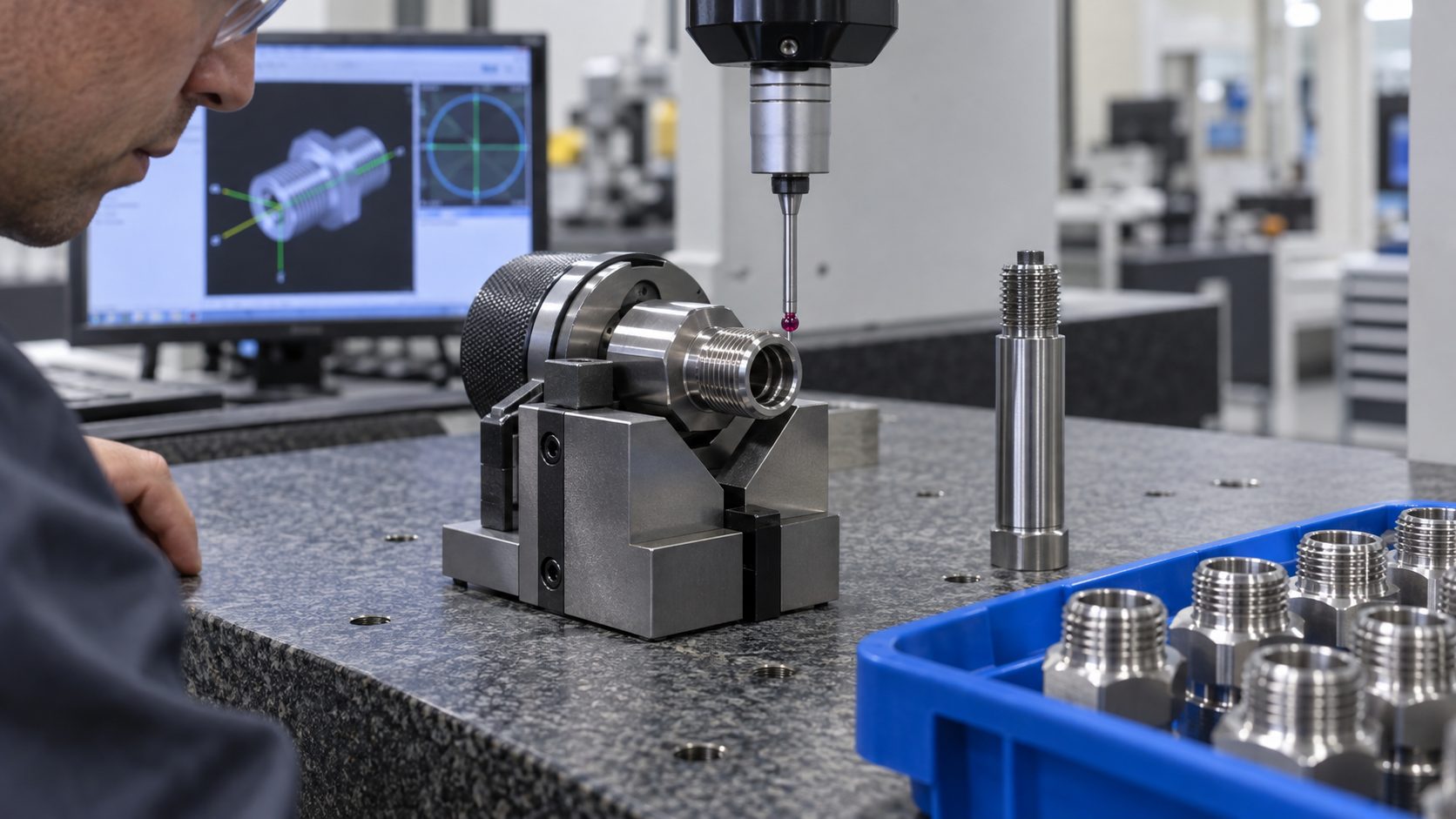
A thread can pass a plug or ring gauge while its pitch axis is offset from the bore or sealing cone. The part may then cross-thread, load a seal unevenly or restrict a mating probe. Process planning must preserve one functional axis.
Create the functional axis in the first setup
Whenever possible, finish the datum bore, sealing feature and critical thread without releasing the part. Use stable collet or soft-jaw contact away from sealing surfaces. If a second operation is required, transfer from a finished cylindrical datum and control clamping force so the thin adapter does not distort.
Control the thread without chasing size alone
Select tapping, thread turning or thread milling from material, wall thickness and adjustability needs. Thread milling permits radius correction and lower cutting force for some parts. Monitor tool wear, burrs at the thread runout and lead-in damage; a correct gauge fit does not prove the thread axis is correctly located.
Match the inspection method to function
Measure the bore and sealing geometry from the drawing datums, then establish the thread axis with an agreed method such as a qualified functional mandrel or a validated helical CMM strategy. Report coaxiality or runout together with thread gauge result, datum construction and measurement uncertainty.