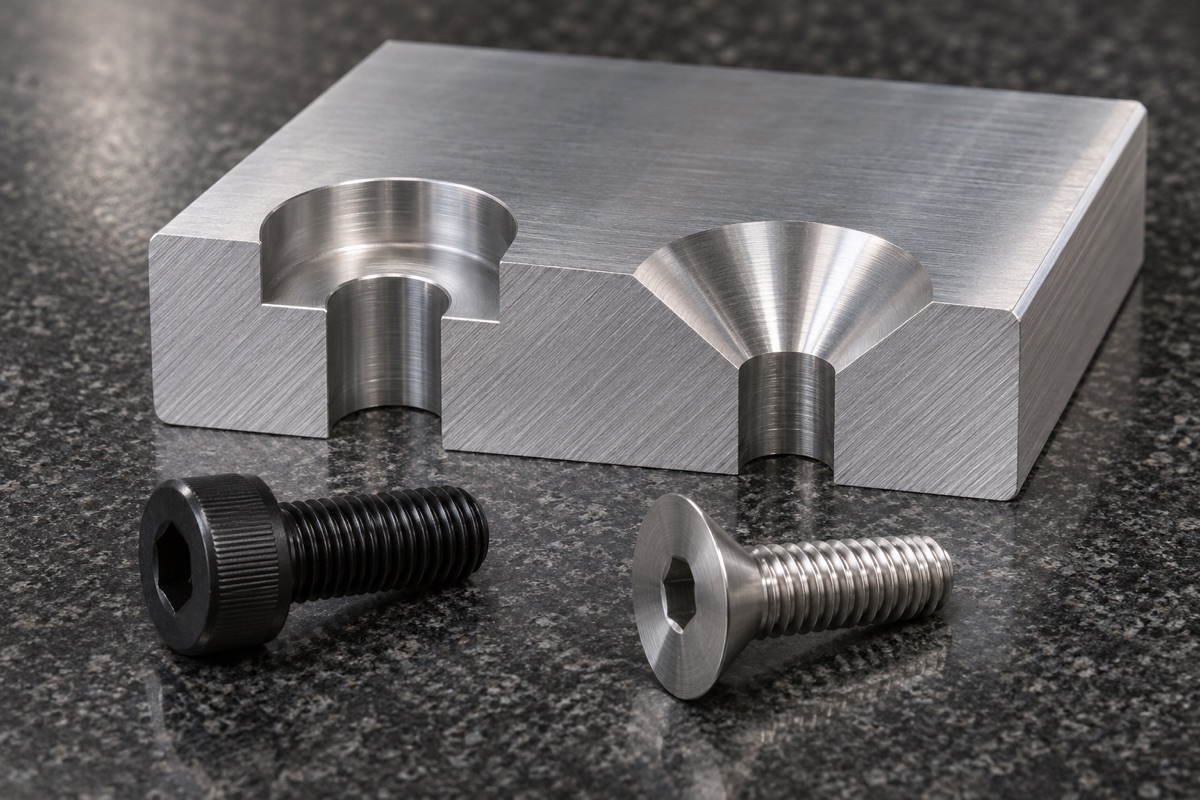
When a cover rocks on one screw, a deeper hole is not necessarily the fix. A cylindrical head bears on a flat shoulder; a countersunk head bears on a cone. If the only problem is a rough mounting face, a shallow spotface can give a sound seat without burying the head.
Start with the clearance under the cover
Put the purchased screw and any washer in the assembly section. Dimension the permitted head projection or recess from the finished bracket face. A head that clears a pocket in the cover does not have to sit flush with the whole bracket.
Give the shop the right hole callout
For a cap screw, specify counterbore diameter, depth and through-hole diameter. For a flat-head screw, specify the major diameter and included angle that match its drawing. For a spotface, define usable bearing diameter and how much stock may be removed. An edge-break note is not a seat specification.
Budget the remaining web
If local thickness can be as little as 4.0 mm and the counterbore as deep as 3.0 mm, only 1.0 mm remains beneath the annular seat. That is a dimensional check, not a strength approval. Recalculate at any opposing pocket rather than using nominal stock thickness.
Accept an assembled first article
After finishing, fit the specified fastener and washer. Bridge the adjacent face and check projection or recess, then try the actual cover. For a machining quote send the section, fastener part number, finish and minimum installed clearance.