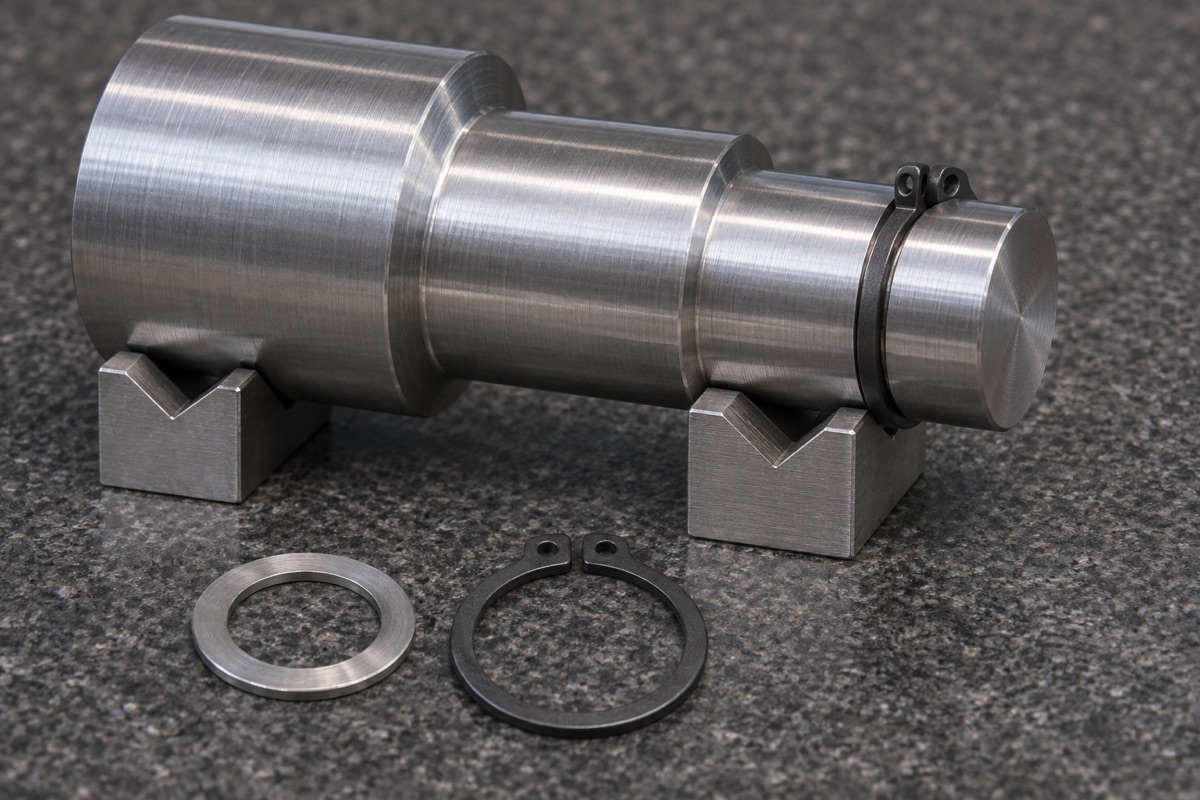
A click during installation does not mean a spacer is axially located without play. Ring seating and assembled endplay are separate checks. This guide considers a conventional external retaining ring, not a bowed or beveled ring designed to take up clearance.
Choose the ring before releasing the groove
Record the ring part number, shaft material and heat treatment, load direction and allowed play. Specify root diameter, width, corner radius and end margin for that ring family. A ring fitting the groove is not proof of load capacity. An end-adjacent groove or an impact-loaded joint needs design review of both the groove wall and shaft.
Put the axial stack on one section
Include the shoulder, spacer, any washers and the ring's actual loaded face. In an illustrative stack, 20.10 mm of effective space around 20.00 mm of retained components leaves 0.10 mm nominal play. The tolerance limits still determine the possible extremes. Narrowing the groove cannot correct a groove located too far from the shoulder.
Look beyond width
An excessive root radius can keep the ring from seating fully; a large chamfer on the retained spacer can reduce its support against the ring. Inspect groove profile, location, burrs and the related shoulder. Recheck functional dimensions after a coating or heat-treatment operation if those operations can change them.
Record the assembled first article
Install an undamaged ring using its specified tooling, verify seating around the circumference, then measure with the real spacer stack under the agreed method. Keep dimensional acceptance separate from load verification. Send Vietlink Precision the shaft drawing, ring code, stack components, quantity and endplay limits for quotation.