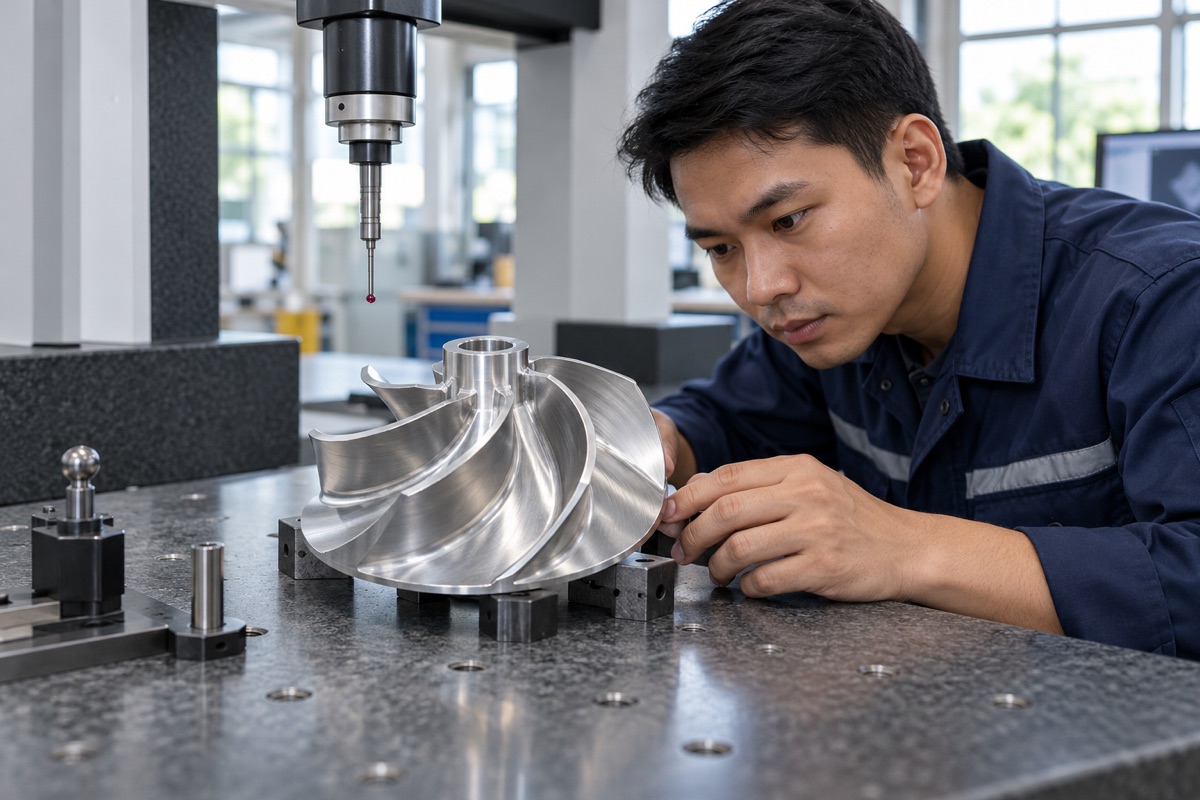
A prototype impeller must fit its shaft and housing as well as meet the drawing. Blade profile alone does not reveal rub, runout or clearance at the operating assembly.
Start with the operating stack
Send the 3D model, shaft fit, housing envelope, rotation direction and fluid conditions. Identify the blade surfaces and diameters that actually control clearance.
Review machining access
Blade count, channel depth and tool reach affect process choice. Ask the shop to confirm equipment access and whether split operations or custom holding will be needed before accepting a delivery date.
Measure function, not appearance
Inspect bore size, datum-face runout, critical blade positions and minimum housing clearance. Agree whether balance, roughness or pressure testing is in scope; do not assume they come with dimensional inspection.
Release a controlled prototype
Record drawing revision, material, deburring method and inspection points. Send a mating shaft or housing sample if possible, then use prototype findings to revise the production drawing.