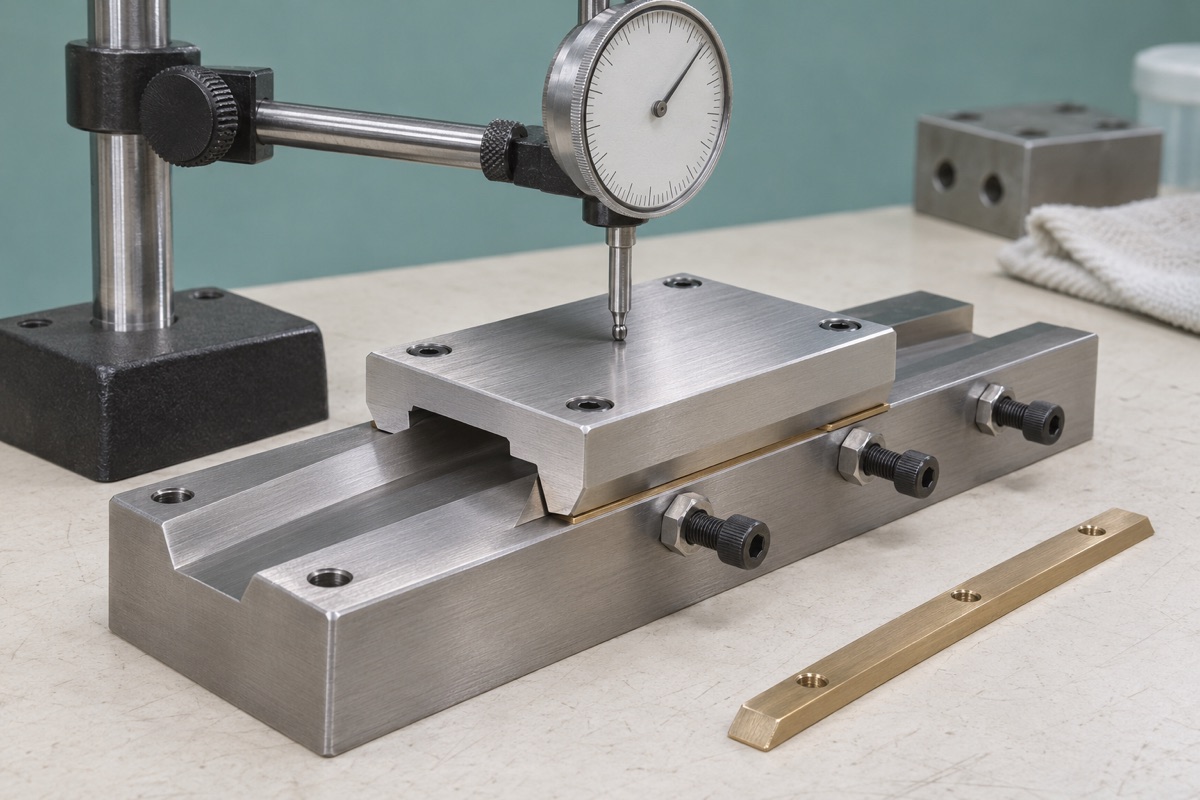
A dovetail slide can provide lockable linear adjustment in an inspection fixture or small positioning tool. The useful acceptance criterion is not simply that it feels smooth by hand. Travel must remain consistent under the agreed load, lubrication and locking conditions. Treat the base, saddle and gib as mating components.
Define the mating section and measurement reference
Show how the dovetail angle is defined, the reference width, effective contact length, gib position and adjustment arrangement. A nominal width measured at different heights is not the same dimension. If using a measurement over pins or another indirect method, specify pin diameter and the procedure so manufacturing and acceptance use the same definition.
Use the gib for adjustment, not to hide guide errors
Sherline describes the gib as an adjustment component in a dovetail fit: excessive tightening restricts motion, while looseness permits lateral play. If the slide is loose midway but tight at the ends, investigate contact geometry, straightness and mounting distortion before tightening individual screws further. A parallel gib and a tapered gib work differently and are not interchangeable by outline alone.
Choose materials and finishes as a mating pair
Select base, saddle and gib materials together, considering wear, environment, lubrication and replacement plans. Specifying hardness on the saddle alone leaves the opposing contact surface unresolved. Decide whether milling needs subsequent grinding, fitting or another finishing operation from the geometry and contact requirements. Coatings change fit dimensions, so identify treated surfaces and the final inspection condition.
Record results at both ends and in the middle
Check variation in drive effort and lateral and vertical displacement along the agreed travel. Under the specified load, measure position before and after locking, using consistent test-force direction and magnitude. Assess lead-screw reversal backlash separately; tightening the gib cannot remove it. Send Vietlink Precision mating models, sections, travel, loads and moments, lubrication conditions, adjustment details and acceptance methods to define individual-part or matched-assembly supply.